Saturday, January 11, 2014

Cold Energy (Episode 2)

Title: Cold Energy - An Alex Cave Center (Episode 2)
Written by James M. Corkill
Book description.
When the Polar Ice sheet mysteriously expands by thousands of square miles in 30 minutes, initial thoughts are an end to global warming, but when the expansions continue, global weather patterns are severely altered and the devastation is horrific on a planetary scale. Things go from bad to worse when Alex Cave receives a call stating the polar ice sheet is going through a continuing series of massive expansions, rapidly freezing the East Siberian and Beaufort Seas above Alaska. Alex begins to piece together the clues of what could be causing these unusual events, and where the clues lead him is almost unbelievable. The ever expanding ice sheet is also changing the balance of the planet, and the earth begins to change its axis. Can Alex find a solution before it is too late? Or will humanity be extinguished by COLD ENERGY.


Download
Just click the link below to download this book.

Tuesday, January 07, 2014

Making Scrapbook

Level: English for Junior High School
24-hours online learning

Direction:
Read the text below attentively and do the test.
Making Scrapbook
Scrapbook is a book with empty pages where you can stick pictures, newspaper articles, or other things you want to keep. You can use drawing books or you can make your own scrapbook by using HVS paper. Stick your HVS paper together with strong paper glue, use your own creativity to create its cover.
These are some steps how to make scrapbook. First of all, prepare about 10 sheets of HVS paper, paper glue 1, thick paper (for its cover), some stickers, pictures or other accessories. Step one, glue together all the HVS papers on its left side or on its top side. Glue it about 2 cm on each side you choose (left or top). Step two, make the cover. Stick all the accessories you have chosen to the front cover, then stick it to the HVS. Your scrapbook is ready to use.
Source: English in Focus, Grade 7 for Junior High School

Exercise
Check your comprehension by doing the test.
Just click the link below.

Note:
This comprehension test is for personal use and protected with user ID and password. You can contact the administrator to get them at elc-solo.

Monday, January 06, 2014

Exposition (Hortatory) - (Concept - Example)

Level: English for Senior High School
24-hours online learning.

Explanation
Social Function
  • To persuade reader or listener that something should or should not be the case.
Generic Structure
  • Thesis: announcement of issue concern.
  • Arguments: reasons for concern, leading to recommendation.
  • Recommendation: statement of what ought or ought not to happen.
Significant
Lexicogrammatical Features
  • Focus on generic human and non-human participants, except for speaker or writer referring to self.
  • Use of:
    • Mental Processes: to state what writer thinks or feels about issue, e.g. realize, feel, appreciate.
    • Material Processes: to state what happens, e.g., is polluting, drive, travel, spend, should be treated.
    • Relational Processes: to state what is or should be, e.g., doesn't seem to have been, is.
  • Use of simple present tense.
Example
Read the text below attentively.
Country Concern

In all the discussion over the removal of lead from petrol (and the atmosphere) there doesn't seem to have been any mention of the difference between driving in the city and the country.
When I realized my leaded petrol car is polluting the air wherever I drive, I feel that when you travel through the country, where you only see another car every five to ten minutes, the problem is not as severe as when traffic is concentrated on city roads.
Those who want to penalize order, leaded petrol vehicles and their owners don't seem to appreciate that, in the country, there is no public transport to fall back upon and one's own vehicles is the only way to get about.
I feel that country people. who often have to travel huge distances to the nearest town and who already spend a great deal of money on petrol, should be treated differently to the people who live in the city.

Wednesday, January 01, 2014

Exposition (Analytical) - (Concept - Example)

Level: English for Senior High School
24-hours online learning.

Explanation
Social Function
  • To persuade reader or listener that something is the case.
Generic Structure
  • Thesis. It contains Position, which introduces topic and indicates writer's position, and Preview, which outlines the main arguments to be presented.
  • Arguments. It contains Point, which restates main arguments outlined in Preview, and Elaboration, which develops and supports each point/argument.
  • Reiteration. It restates writer's position.
Significant
Lexicogrammatical Features
  • Focus on generic human and non-human participants.
  • Use of simple present tense.
  • Use of relational processes.
  • Use of internal conjunction to state argument.
  • Reasoning through causal conjunction or nominalization.
Example
Read the text below attentively.
Three Level of Government in Australia
In Australia, there are three level of governments, the federal government, state governments and local governments. All of these levels of government are necessary. This is so for a number of reasons.
First, the federal government is necessary for the big things. They keep the economy in order and look after things like defense. Similarly, the state governments look after the middle sized things. For example, they look after law and order, preventing things like vandalism in schools. Finally, local governments look after the small things. They look after things like collecting rubbish, otherwise everyone would have diseases.
Thus, for the reasons above we can conclude that the three level governments is necessary.

Tuesday, December 31, 2013

Explanation (Concept - Example)

Level: English for Senior High School
24-hours online learning.

Explanation
Social Function
  • To explain the processes involved in the formation or workings of natural or sociocultural phenomena.
Generic Structure
  • A general statement to position the reader.
  • A sequenced explanation of why or how something occurs.
Significant
Lexicogrammatical Features
  • Focus on generic, non - human participants.
  • Use mainly of material and relational processes.
  • Use mainly of temporal and causal circumstances and conjunctions.
  • Some use of passive voice to get theme right.
Example
Read the text below attentively.
Where Does Rain Come From?
Rain always comes from clouds. But where do clouds come from? How does all that water get into the sky?
Think about your bathroom. There is hot water in your bath. Steam goes up from the hot water. The steam makes small clouds in the bathroom. These warm clouds meet the cold walls and windows, and then we see small drops of water on the walls and windows.
The world is like your bathroom. The water in the oceans is warm when the sun shines on it. Some of this water goes up into the sky and makes clouds. The wind carries the clouds for hundreds of kilometers. Then the clouds meet cold air in the sky, and we see drops of water. The drops of water are rain.
The rain falls and runs into rivers.Rivers run into oceans. And the water from oceans makes clouds and more rain. So water is always moving from oceans to clouds to rain to rivers to oceans. So the rain on your head was on other heads before! The water in your garden was in other gardens in other countries.

Adapted from Junior Comprehension 1, 1999

Monday, December 30, 2013

Anecdote (Concept - Example)

Level: English for Senior High School
24-hours online learning.

Explanation
Social Function
  • To share with others an account of an unusual or amusing incident.
Generic Structure
  • Abstract: signals the retelling of an unusual incident.
  • Orientation: set the scene.
  • Crisis: provide details of the unusual incident.
  • Reaction: reaction to crisis.
  • Coda: optional - reflection on or evaluation of the incident.
Significant
Lexicogrammatical Features
  • Use the exclamations, rhetorical questions and intensifiers (really, very, quite, etc.) to point up the significance of the events.
  • Use of material processes to tell what happened.
  • Use of temporal conjunction.
Example
Read the text below attentively.
Snake in the Bath
How would you like to find a snake in your bath? A nasty one too!
We had just moved into a new house, which had been empty for so long that everything was in a terrible mess. Anna and I decided that we would clean the bath first, so we set to, and turned on the tap.
Suddenly to my horror, a snake's head appeared in the plug-hole. Then out slithered the rest of his long thin body. He twisted and turned on the slippery bottom of the bath, spitting and hissing at us.
For an instant I stood there quite paralyzed. Then I yelled for my husband, who luckily came running and killed the snake with the handle of a broom. Anna, who was only three at the time, was quite interested in the whole business. Indeed I had to pull her out of the way or she'd probably had lent over the bath to get a better look!
Ever since then I've always put the plug in firmly before running the bath water.

Tryout 1 - English National Exam

Level: English for Senior High School
24-hours online learning.

Simulation test 1, which is specialized for the students of senior high school,  is designed to measure the students' readiness to take English National Exam. The content of this test is arranged in accordance with the passing standard determined by the department of education and culture of Indonesia.

The test consists of 50 questions which are divided into three skills of English, listening, reading and writing. All the questions are in the form of multiple choice and the students must complete this test for 90 minutes. The passing grade of this test is 8.00. If the students achieve the target score, they will be able to take the next simulation.

To join this test, just click the link below.

Requirement:
Students can take this tryout if they join the course for eight meetings without being absent or asking for permission.

Note:
This simulation test is protected with user ID and password. You can contact the administrator to get them if you want to take this test seriously. Test Code: S121330.

Sunday, December 29, 2013

News Item (Concept - Example)

Level: English for Senior High School
24-hours online learning.

Explanation
Social Function
  • To inform readers, listeners, or viewers about events of the day which are considered newsworthy or important.
Generic Structure
  • Newsworthy Event(s): recounts the event in summary form.
  • Background Events: elaborate what happened, to whom, in what circumstances.
  • Sources: comments by participants in, witnesses to and authorities expert on the event.
Significant Lexicogrammatical Features
  • Short, telegraphic information about story captured in headline.
  • Use of Material Processes to retell the event (in the text below, many of the Material Processes are nominalised.
  • Use of projecting Verbal Processes in Sources stage.
  • Focus on Circumstances (e.g. mostly within Qualifiers).
Example
Read the text below attentively.
Seven Killed in Accident on Jalan Sultan

Seven people were killed in a collision between a bus, a car and a truck at 10:35 p.m. on Jalan Sultan last night.
The dead were all passengers in the car. Police believe the car may have been trying to overtake the  bus when it was struck by a truck coming from the opposite direction. The driver of the car may not have been using his lights, as the truck driver said he did not see the car approaching.
The police said the car should not have been trying to pass the bus, since overtaking is not allowed on Jalan Sultan. In addition, the police reported that the car - a small Japanese car - should not have been carrying more than five people. The names of the victims are not yet known.
Source: www.thejakartapost.com

Saturday, December 28, 2013

Report Text (Concept - Example)

Level: English for Junior and Senior High School
24-hours online learning.

Explanation
Social Function
  • To describe the way things are, with reference to a range of natural, man-made and social phenomena in our environment.
Generic Structure
  • General Classification: tells what the phenomenon under discussion is.
  • Description: tells what the phenomenon under discussion is like in term of (1) parts, (2) qualities, (3) habits or behaviors, if living; uses, if non-natural.
Significant
Lexicogrammatical Features
  • Focus on Generic Participants.
  • Use of Relational Processes to state what is and that which it is.
  • Use of Simple Present Tense (unless extinct)
  • No temporal sequence.
Example
Read the text below attentively.
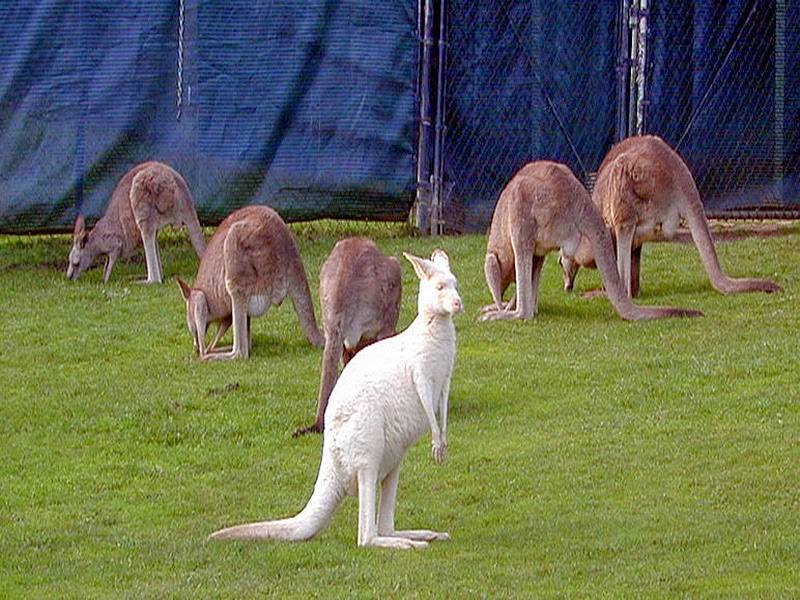
Kangaroo
A kangaroo is an animal found only in Australia, although it has a smaller relative, called wallaby, which lives on the Australian island of Tasmania and also in New Guinea.
Kangaroos eat grass and plants. They have short front legs, but very long, and very strong back legs and a tail. These are used for sitting up and for jumping. Kangaroos have been known to make forward jumps of over eight meters, and leap across fences more than three meters high. They can also run at speeds of over 45 kilometers per hour.
The largest kangaroos are the Great Grey Kangaroo and the Red Kangaroo. Adult grow to a length of 1.60 meters and weigh over 90 kilos.
Kangaroos are marsupials. This means that the female kangaroo has an external pouch on the front pf her body. A baby kangaroo is very tiny when it is born, and it crawls at once into this pouch where it spends its first five months of life.
Taken from: Peter Haddock Ltd. Ref. 083

Friday, December 27, 2013

Recount Text (Concept - Example)

Level: English for Junior and Senior High School
24-hours online learning.

Explanation
Social Function
  • To retell events for the purpose of informing or entertaining.
Generic Structure
  • Orientation: provides the setting and introduces participants.
  • Events: tell what happened, in what sequence.
  • Reorientation: optional - closure of events.
Significant
Lexicogrammatical Features
  • Focus on specific participants.
  • Use of Material Processes.
  • Circumstances of time and place.
  • Use of past tense.
  • Focus on temporal sequence.
Example
Read the text below attentively.
The Clever Servant
 This is an old story. It was first told long ago. A rich man wanted to make a journey to another town. He was a businessman. He wanted to take things to sell. He also wanted to take gold to buy things with. He decided to take ten servants with him. They would carry the things to sell and the gold, and also food to eat on the journey.
He was a kind man. He said to one of his servants, "You are the smallest, the thinnest and the weakest of all my servants. You cannot carry a heavy load. You must choose the lightest load to carry."
The servant thanked his master for his kindness. He pointed to the biggest load. This was bread to eat on the journey.
His master said, "You are foolish. That is the biggest and heaviest load." But the servant picked up the load cheerfully and the journey began. They walked for four hours. Then, they stopped for a rest. They all ate some of the bread. There was less bread for the servant to carry. The servant's load grew smaller and lighter every day. At the end of the journey, the servant had nothing to carry.